
Health guide
Getting enough sleep at sea
Tiredness is one of the biggest risks on a ship. It slows your thinking and can put you to sleep on watch without warning. The rules give you minimum rest. These tips help you use it well.
Tired is not weak. It is a safety risk, and there are rules to protect you.
The short version
- You must get at least 10 hours of rest in any 24 hours.
- You must get at least 77 hours of rest in any 7 days.
- Rest can be split into no more than 2 periods, and one must be at least 6 hours.
- The best nap is about 20 minutes. Longer than 30 minutes can leave you groggy.
- Fatigue is worst between 3 and 5 in the morning.
We wrote this from the sources at the end. Last checked . We're looking for a doctor to review every page. How we write. Spot a mistake? Tell us.
Your hours of rest
The Maritime Labour Convention (MLC 2006) sets limits on work and rest. Each flag state picks one of two ways to set them:
| Most work allowed | Or least rest allowed |
|---|---|
| 14 hours in any 24 hours | 10 hours in any 24 hours |
| 72 hours in any 7 days | 77 hours in any 7 days |
- Rest can be split into no more than 2 periods. One must be at least 6 hours long.
- The gap between rest periods must not be more than 14 hours.
- Drills should be run in a way that disturbs rest as little as possible.
- If you are on call and get called out during rest, you should get enough rest to make up for it.
- A table of the work schedule must be posted where you can see it.
- Your daily hours must be recorded. You must get a copy of your records, signed by the master and by you.
The STCW Convention sets the same minimum for watchkeepers: 10 hours of rest in any 24 hours and 77 hours in any 7 days. Flag states can allow some exceptions. Even then, you must get at least 70 hours of rest in any 7 days. The weekly rest can only be cut like this for 2 weeks in a row at most.
Rest records
Fill in your rest hours honestly. True records protect you, your shipmates and the ship.
The danger signs of fatigue
- Your eyelids droop or close slowly. You yawn and nod off.
- You read the same line again and again, or forget what you just did.
- You miss things, misjudge distance, speed or time, or make risky choices.
- You react slowly to alarms or calls.
- You feel irritable or low, or stop caring about the job.
The worst danger is a microsleep. This is a sleep of a few seconds that you do not notice. Your brain stops taking in what you see and hear. It is most likely when you have lost sleep for days, and in the early hours of the morning.
Nodding off on watch
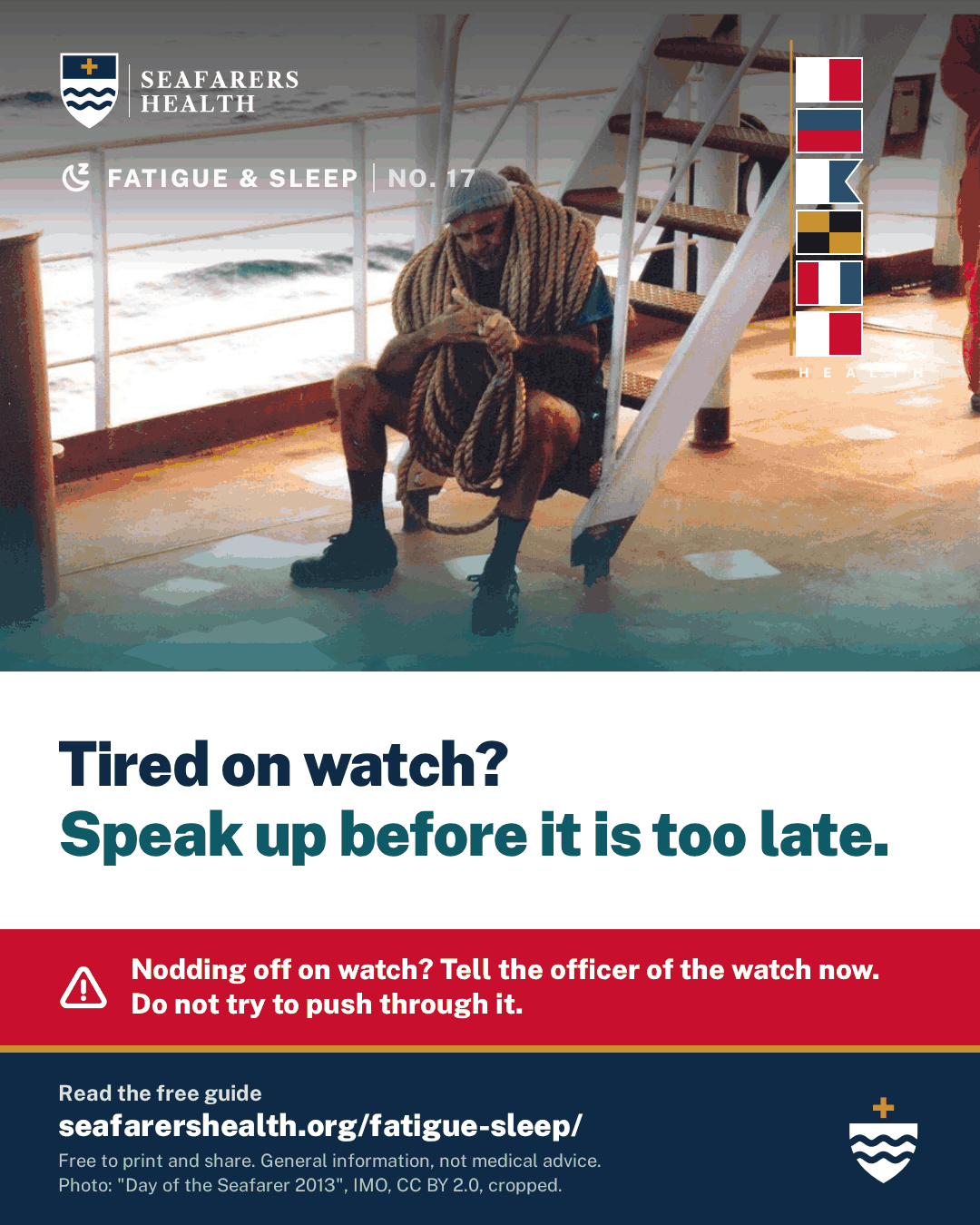
If you feel yourself nodding off, or see it in a shipmate, act now. Call the officer of the watch or the master and ask for relief. Do not try to fight it alone.
Sleep better on a ship
- Sleep in one long block when you can. One 6-hour sleep is worth more than six 1-hour naps.
- Make the cabin dark, quiet and cool. Use earplugs and an eye mask. Black plastic over the porthole works.
- Avoid caffeine for at least 6 hours before you sleep.
- Avoid alcohol before sleep. It makes sleep worse.
- Do not eat a big meal right before bed.
- Put your phone down before bed. Screen light makes it harder to fall asleep.
- Ask not to be disturbed during your rest, unless it is an emergency.
How to nap
A short nap gives a strong boost. Even 10 to 15 minutes helps. About 20 minutes is best. Naps longer than 30 minutes can leave you groggy for up to 20 minutes after you wake. Plan naps as part of your rest. Skip naps if you find it hard to sleep in your main rest time.
How to use coffee
- Caffeine takes 15 to 30 minutes to work. Drink it just before you need it.
- Its level in your body halves every 5 to 6 hours, so a late coffee can spoil your sleep.
- Up to 400 mg a day is safe for most healthy adults. In pregnancy the safe limit is 200 mg a day.
- Coffee and energy drinks do not replace sleep. Only sleep fixes fatigue.
When tiredness is a health problem
Sleep apnoea is when breathing stops and starts in your sleep. Signs are loud snoring, gasping or choking in sleep, and feeling very tired all day. Ask your cabin mate if you snore or stop breathing. See a doctor at home. Sleep apnoea can be treated. Under the ILO/IMO guidelines, you can usually work again once treatment is shown to work, with more frequent checks.
Alcohol and duty
STCW sets a limit for watchkeepers and crew with safety duties of 0.05% blood alcohol, or 0.25 mg per litre of breath. Many companies allow no alcohol at all. Check your company's rules.
Common questions
How many hours of rest must seafarers have?
At least 10 hours in any 24-hour period and 77 hours in any 7-day period. That is the minimum in the MLC 2006 and the STCW Convention. Some flag states set limits on work hours instead, of 14 hours a day and 72 hours a week.
Can hours of rest be split into more than two periods?
Normally no. Rest can be split into no more than 2 periods, and one must be at least 6 hours long. Some approved exceptions allow 3 periods on up to 2 days a week.
How long should a nap be on a ship?
About 20 minutes is best. Even 10 to 15 minutes helps. Naps longer than 30 minutes can leave you groggy for a while after you wake.
What are the signs of fatigue at sea?
Drooping eyelids, nodding off, slow reactions, poor memory and bad decisions are the main signs. Feeling irritable is another. If you nod off on watch, call for relief at once.
Does coffee help with fatigue?
It helps for a short time, but it does not replace sleep. It takes 15 to 30 minutes to work and can spoil your next sleep. Stop caffeine at least 6 hours before you sleep.
Quick self-check
Tick what is true for you. Your answers stay on this phone.
Want a monthly all-round check on paper? Get the Fit on Board self-check (PDF, 29 KB).

Poster for the mess room
Free to print and share. Pin it up this week.
Sources
- ILO Maritime Labour Convention 2006, as amended, Standard A2.3 (hours of work and rest) (checked 2026-11-15)
- UK MCA MGN 566: STCW Manila amendments, hours of rest and alcohol limits (checked 2026-11-15)
- IMO Guidelines on fatigue, MSC.1/Circ.1598 (checked 2026-11-15)
- EFSA: Caffeine (checked 2026-11-15)
- NHS: Sleep apnoea (checked 2026-11-15)
- ILO/IMO Guidelines on the medical examinations of seafarers (sleep apnoea) (checked 2026-11-15)
Know a shipmate who might need this? Send them this guide. It is free and it loads on slow ship internet.
Send on WhatsAppDid this help you?
Thank you. Please send it to a shipmate who might need it.
Thank you. What was missing? Tell us and we will improve it.
Seafarers Health. seafarershealth.org/fatigue-sleep/ Last updated 15 November 2026. General information, not medical advice. Free to print and share.