
Health guide
Your weight and waist at sea
Many seafarers put on weight on every contract and never quite lose it at home. The scales tell part of the story. Your waist tells more, because fat around the middle drives heart disease, diabetes and high blood pressure.
The short version
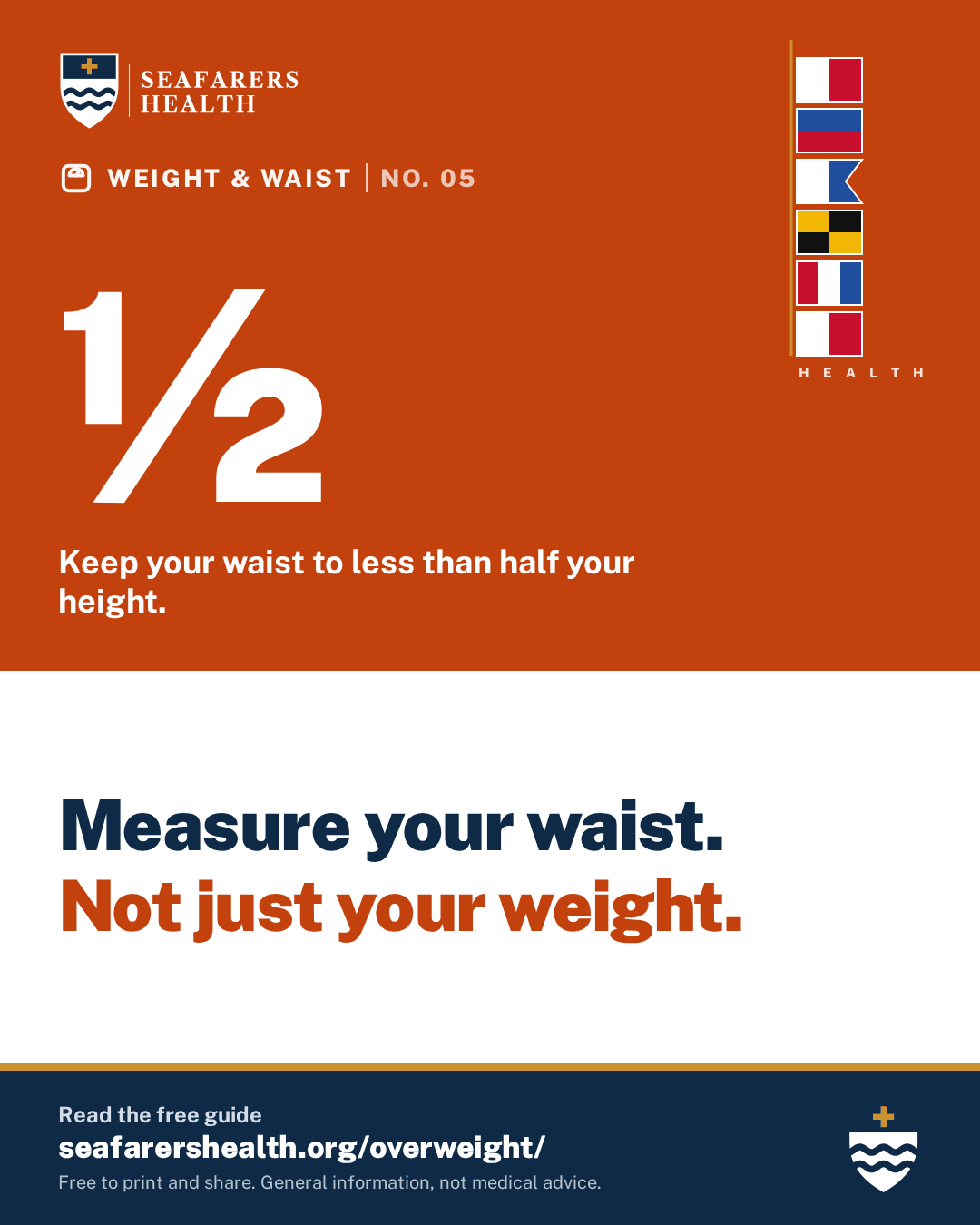
- Keep your waist to less than half your height.
- Asian men are at higher risk above about 90 cm, Asian women above 80 cm.
- Being very overweight can make it hard to do emergency duties.
- Measure your waist on the first day of each month.
We wrote this from the sources at the end. Last checked . We're looking for a doctor to review every page. How we write. Spot a mistake? Tell us.
How to measure your waist
Stand up straight and breathe out normally. Find the point halfway between your lowest rib and the top of your hip bone. Wrap a tape measure around there. Keep it snug but not tight. Do not pull your stomach in.
What the numbers mean
| Higher risk | Much higher risk | |
|---|---|---|
| Men | over 94 cm (37 in) | over 102 cm (40 in) |
| Women | over 80 cm (31.5 in) | over 88 cm (34.5 in) |
These are the WHO numbers for people of European descent. For Asian seafarers, lower numbers are used. That includes Filipino, Indonesian, Myanmar, Indian and Chinese crews. Risk rises above about 90 cm for men and 80 cm for women.
A simple rule works for everyone. Keep your waist to less than half your height. If you are 170 cm tall, aim for a waist under 85 cm.
Why it matters for your job
Being very overweight makes it harder to climb ladders, fit through manholes and escape hatches, and wear breathing apparatus. It also makes it harder to survive in the water. The medical exam checks that you can do your emergency duties.
Your medical certificate
High blood pressure, diabetes and sleep apnoea are linked to weight. They are common reasons for a restricted certificate. See medical certificates.
Small changes that add up
- Take a smaller first serving and wait before going back.
- Swap sweet drinks and energy drinks for water.
- Swap the night-watch biscuits for fruit or nuts.
- Move every day. See Fit on Board.
- Measure your waist on the first day of each month. Write it down.
Common questions
What waist size is healthy for a man?
For most men, under 94 cm is the healthy range. For Asian men, aim for under about 90 cm. The simplest rule is a waist less than half your height.
What waist size is healthy for a woman?
Under 80 cm is the healthy range for women. The simplest rule for everyone is a waist less than half your height.
Can I fail my medical for being overweight?
You can, if your weight stops you doing your duties safely. The doctor checks things like ladders, escape hatches and breathing apparatus. Weight-linked problems like high blood pressure can also lead to a restricted certificate.
Why do seafarers put on weight at sea?
Big meals, snacks on night watch and little room to move are common reasons. Over a long contract, small daily extras add up.
Quick self-check
Tick what is true for you. Your answers stay on this phone.
Want a monthly all-round check on paper? Get the Fit on Board self-check (PDF, 29 KB).

Poster for the mess room
Free to print and share. Pin it up this week.
Sources
Know a shipmate who might need this? Send them this guide. It is free and it loads on slow ship internet.
Send on WhatsAppDid this help you?
Thank you. Please send it to a shipmate who might need it.
Thank you. What was missing? Tell us and we will improve it.
Seafarers Health. seafarershealth.org/overweight/ Last updated 15 November 2026. General information, not medical advice. Free to print and share.