
Health guide
A medical emergency at sea
In a medical emergency on board, act fast and get expert help. Alert the master and the officer in charge of medical care. Then get radio medical advice from a doctor ashore. It is free, day and night.
The short version
- Alert the master and the officer in charge of medical care first.
- Radio medical advice is free for every ship, 24 hours a day.
- Contact a coast radio station or rescue centre (MRCC). They connect you to a doctor.
- Have the patient's details and signs ready before you call.
- Write down the advice and read it back.
We wrote this from the sources at the end. Last checked . We're looking for a doctor to review every page. How we write. Spot a mistake? Tell us.
This page does not replace radio medical advice
It is general information to help you get ready. In a real emergency, alert the master or the officer in charge of medical care. Then get radio medical advice straight away.
The first steps
Make it safe and raise the alarm
Check for danger to yourself and others, such as gas, fire, machinery or a closed space. Do not become a second casualty. Never go into an enclosed space to rescue someone without breathing apparatus and the rescue team. Raise the alarm and wait for them.
Alert the master and the officer in charge of medical care
Every ship without a doctor must have a trained person in charge of medical care. Call them and the bridge at once.
Give first aid
Check breathing. Stop heavy bleeding. Keep the person warm and still. Start CPR if they are not breathing normally. See the first aid basics below.
Get radio medical advice
The master or officer contacts a coast radio station or rescue centre. They connect the ship to a doctor at a telemedical service.
Follow the advice and keep notes
Write down what the doctor says and what you give, with times. Read the advice back to check it.
First aid basics
Do these while help is coming. Your ship's medical guide has the full steps.
- Not breathing normally. Start CPR. Push hard and fast in the centre of the chest, 30 pushes then 2 breaths. Send someone for the defibrillator (AED) if the ship has one. Switch it on and do what it says.
- Breathing but not awake. Put them on their side so they can breathe. After a fall from height, keep the head and neck still unless you must move them to keep them breathing or safe.
- Heavy bleeding. Press hard on the wound with a clean pad. Keep pressing. Add more pads on top.
- Choking. Give up to 5 sharp blows between the shoulder blades. Then up to 5 hard pulls in and up just above the belly button. Repeat.
- Severe allergic reaction. Swelling of the face or throat, wheezing or collapse. Give adrenaline (epinephrine) from the medicine chest straight away, as your medical guide shows. Then get radio medical advice.
- Burns. Cool with cool running water for 20 minutes. Take off rings and watches. Cover loosely with cling film or a clean dressing.
- Cold water. Handle them gently and keep them flat. Take off wet clothes, dry them and warm them slowly with blankets.
Print our free radio medical call sheet and keep it by the medicine chest. More tools in the crew health toolkit.
What radio medical advice is
A telemedical assistance service (TMAS) is a team of doctors on shore. They give advice to ships by radio, phone or satellite. They are trained for the limits of care at sea. They work with rescue centres, which can arrange evacuation or advise on the nearest port.
- Under the MLC 2006, radio or satellite medical advice must be available 24 hours a day. It must be free to all ships, whatever flag they fly.
- The IMO says these calls should get priority, be free, and be kept private.
How to reach a doctor
- Contact a coast radio station or a maritime rescue coordination centre (MRCC) by DSC, VHF, MF or satellite. Ask for medical advice. They will connect you to a TMAS doctor.
- In an urgent case the call may start with the urgency signal "PAN PAN" and the words "I require medical advice".
- The rescue centre may first ask brief details: the illness or injury, the type of ship, your position and the nearest port.
- Ships should carry an up-to-date list of radio stations that give medical advice. Know where it is kept.
What to have ready before the call
About the ship
- Ship name, call sign and MMSI
- Position, course and speed
- Last port, next port and the nearest port, with how long it would take to reach each
- Weather, if it matters
About the patient
- Age, sex and job on board
- What happened and when it started
- All the signs and complaints
- Temperature, pulse, breathing rate and blood pressure
- Whether they are awake, confused or hard to wake
- Medicines they take, and any medicines given since, with doses and times
- Allergies and past illness
- Any recent malaria ports
- What you want advice on
Privacy
A seafarer's health details must be kept private. The ship's medical report form is secret. It is used only to help with care.
The ship's medical guide and medicine chest
Under the MLC 2006, every ship must carry a medicine chest, medical equipment and a medical guide. The WHO International Medical Guide for Ships is the main world guide. Flag states take it into account when they set the guide and the chest. It covers first aid and the care of common illness and injury on board. It also explains how to use outside medical help. Know where the guide and the chest are kept on your ship. See medicines on board.
Common emergencies at sea
- Chest pain: see heart health.
- Fever after a malaria port: see malaria.
- Someone talking about suicide: see mental health.
- Many crew being sick at once: see food safety.
- Heatstroke: see sun, heat and skin.
- A swollen face or jaw from a tooth: see dental care.
- Leg swelling or sudden breathlessness after travel: see safe travel.
If you are on shore leave, call the local emergency number. Tell the ship and the agent as soon as you can.
Common questions
How do I get medical advice at sea?
Call a coast radio station or a rescue centre (MRCC). Ask for medical advice. They will put you through to a doctor at a telemedical service (TMAS). The master or the officer in charge of medical care usually makes the call.
Is radio medical advice free for ships?
Yes. The MLC 2006 says radio or satellite medical advice must be free to all ships, whatever flag they fly. It must be available 24 hours a day.
What is TMAS?
TMAS stands for telemedical assistance service. It is a team of doctors ashore who give medical advice to ships at sea. They work with rescue centres, which can arrange evacuation if it is needed.
What information does the radio doctor need?
The doctor needs the ship's position and the nearest port. They need the patient's age, what happened and their signs. Give the temperature, pulse and breathing rate, any drugs given and any allergies. Write it all down before you call.
Who is in charge of medical care on a ship?
On ships without a doctor, a trained officer is in charge of medical care, under the master. Their training must meet the STCW rules. Ships carrying 100 or more people on international voyages of more than 3 days must carry a doctor.
What is the International Medical Guide for Ships?
It is a WHO book on medical care at sea for ships without a doctor. It covers first aid, common illness and injury, getting outside help and the ship's medicine chest.
Quick self-check
Tick what is true for you. Your answers stay on this phone.
Want a monthly all-round check on paper? Get the Fit on Board self-check (PDF, 29 KB).

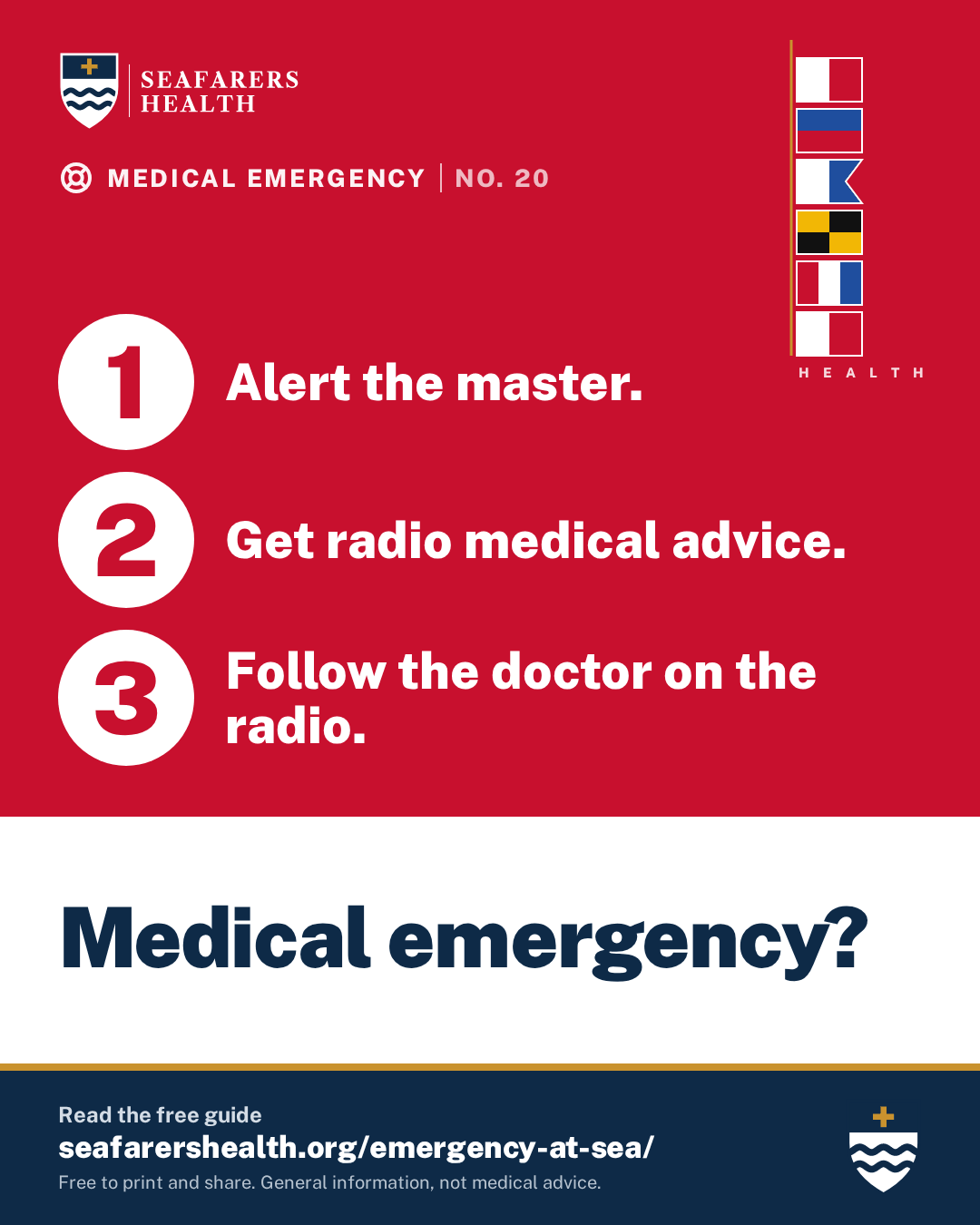
Poster for the mess room
Free to print and share. Pin it up this week.
Sources
- ILO Maritime Labour Convention 2006, as amended, Standard A4.1 and Guideline B4.1.1 (checked 2026-11-15)
- IMO MSC/Circ.960: Medical assistance at sea (checked 2026-11-15)
- UK MCA MGN 623: Telemedical advice service (TMAS) for ships at sea (checked 2026-11-15)
- WHO International Medical Guide for Ships, 3rd edition (checked 2026-11-15)
Know a shipmate who might need this? Send them this guide. It is free and it loads on slow ship internet.
Send on WhatsAppDid this help you?
Thank you. Please send it to a shipmate who might need it.
Thank you. What was missing? Tell us and we will improve it.
Seafarers Health. seafarershealth.org/emergency-at-sea/ Last updated 15 November 2026. General information, not medical advice. Free to print and share.