
Health guide
Sexual health for seafarers
Long months away, short shore leave and ports where HIV and other infections are common mean seafarers face higher risk. The good news is that protection is simple, testing is easy, and HIV can now be treated.
The short version
- Use a condom every time. Bring your own supply.
- PEP can stop HIV, but it must start within 72 hours.
- Get the hepatitis B vaccine before your contract.
- Many infections have no signs at first. Get tested between contracts.
We wrote this from the sources at the end. Last checked . We're looking for a doctor to review every page. How we write. Spot a mistake? Tell us.
The main risks
Sexually transmitted infections (STIs) include chlamydia, gonorrhoea, syphilis, herpes, HPV, hepatitis B and HIV. Many have no signs at first. So you can pass them on without knowing. Some cause infertility, cancer or long-term illness if they are not treated.
How to protect yourself
- Use a condom every time. Bring your own supply. Check the date. Do not use two at once.
- Get the hepatitis B vaccine. It is safe and works well. Ask about the HPV vaccine too.
- Alcohol and drugs make people take risks they would not take sober. Go ashore in pairs and look after each other.
- Tattoos and piercings ashore can spread HIV and hepatitis if needles are not clean.
If you think you were exposed to HIV
Post-exposure prophylaxis (PEP) is a short course of HIV medicine that can stop infection.
PEP must start within 72 hours
The sooner the better. Most ships do not carry PEP. Tell the master or the officer in charge of medical care at once, so a port doctor or evacuation can be arranged in time. Your medical information should be kept private. Getting help fast matters more than feeling embarrassed.
PrEP and testing
- PrEP (pre-exposure prophylaxis) is a medicine that prevents HIV in people at higher risk. Talk to a doctor at home before your contract.
- Get tested between contracts. Get tested any time you have signs such as discharge, sores, pain when you pee, or a rash.
- HIV today is a long-term condition. People on good treatment live normal lives. People on treatment who have an undetectable viral load do not pass HIV on through sex.
Women seafarers
Emergency contraception works best when taken soon after sex. Read women's health at sea before you join.
Common questions
How soon do I need PEP after HIV exposure?
Within 72 hours, and the sooner the better. Tell the officer in charge of medical care or a port doctor straight away. PEP does not work if it starts too late.
Do I need an HIV test before my medical?
It depends on the flag and the employer. Some medicals include blood tests. Testing between contracts is a good habit either way, because many infections have no signs.
Can I still work at sea if I have HIV?
Many people with HIV work at sea. People on good treatment live normal lives. The medical doctor decides on fitness case by case, so take your treatment records to the exam.
Is the hepatitis B vaccine worth it for seafarers?
Yes. Hepatitis B spreads through sex and blood, and the vaccine is safe and works well. Get it at home before your contract.
Quick self-check
Tick what is true for you. Your answers stay on this phone.
Want a monthly all-round check on paper? Get the Fit on Board self-check (PDF, 29 KB).

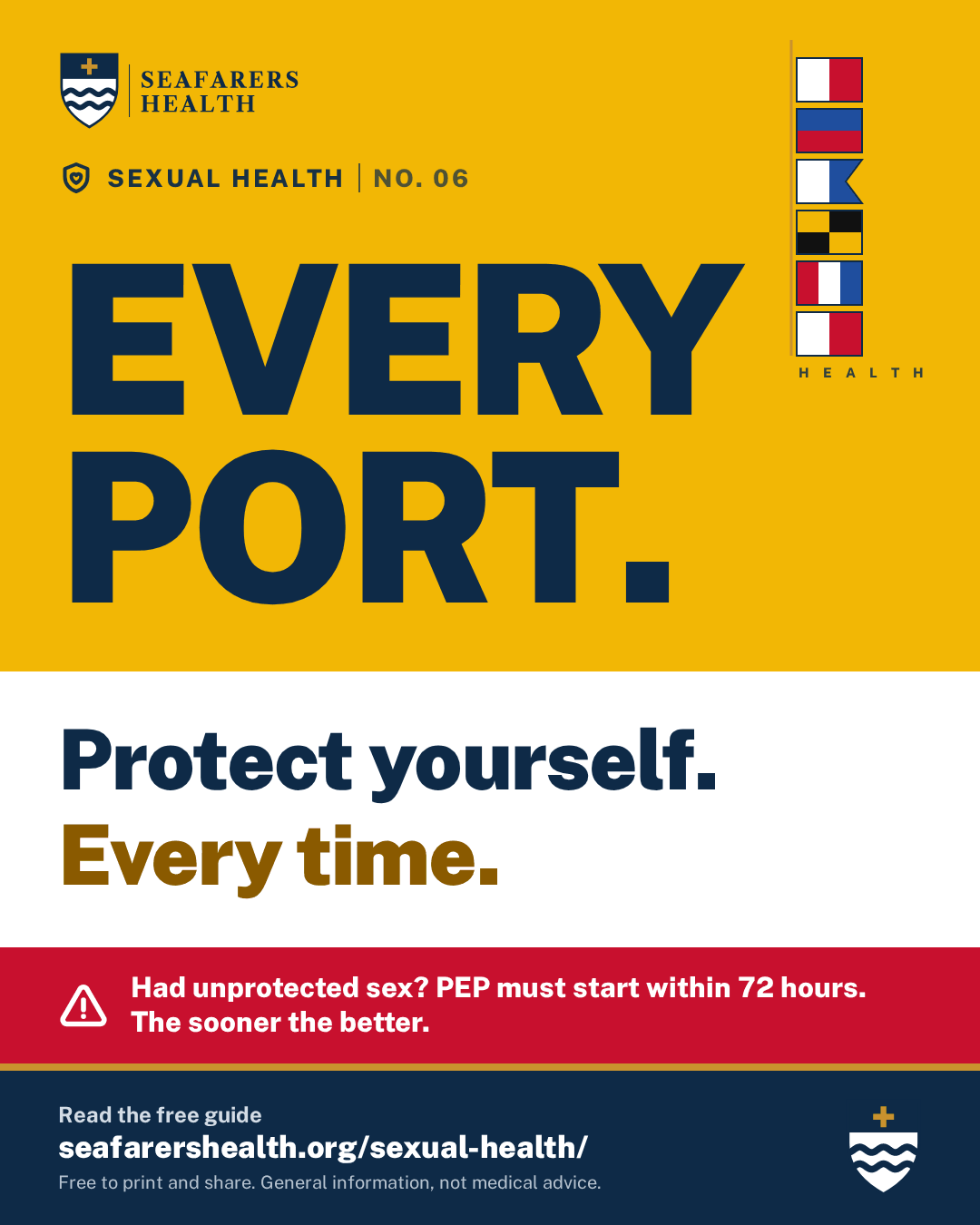
Poster for the mess room
Free to print and share. Pin it up this week.
Sources
Know a shipmate who might need this? Send them this guide. It is free and it loads on slow ship internet.
Send on WhatsAppDid this help you?
Thank you. Please send it to a shipmate who might need it.
Thank you. What was missing? Tell us and we will improve it.
Seafarers Health. seafarershealth.org/sexual-health/ Last updated 15 November 2026. General information, not medical advice. Free to print and share.