
Health guide
Medicines at sea
A ship has its own medicine chest, but it is not a pharmacy. If you take regular medicine, you need a plan before you join. Some rules about carrying medicine change from country to country.
The short version
- Every ship must carry a medicine chest, checked at least every 12 months.
- Tell the doctor at your medical, and the officer in charge of medical care, what you take.
- Never stop an essential medicine to try to pass your medical.
- Many countries limit you to a 30 to 90 day supply of some medicines.
- Never share prescription medicines.
We wrote this from the sources at the end. Last checked . We're looking for a doctor to review every page. How we write. Spot a mistake? Tell us.
The ship's medicine chest
- Under the MLC 2006, every ship must carry a medicine chest, medical equipment and a medical guide.
- The chest should be checked at least every 12 months. Labels, expiry dates and storage should all be checked.
- The officer in charge of medical care looks after the chest and gives medicines from it.
- Before they give strong drugs like antibiotics, they should get radio medical advice.
- The WHO International Medical Guide for Ships gives a model list for the chest.
The chest is for emergencies
It cannot cover a long-term condition for a whole contract. Bring your own supply of any regular medicine.
Your own prescriptions
Tell the doctor at your medical
The doctor checks each one you take. Some can affect your work. Examples are sleeping tablets, insulin, some allergy tablets and some drugs for anxiety or low mood.
Do not stop to pass
Stopping some drugs, like insulin or a blood thinner, can be dangerous. Talk to your doctor instead.
Get a letter from your doctor
It should list your name, each medicine, its strength, your dose and how much you carry. It should be signed by the doctor. Have it in English and keep a copy.
Plan how much to bring
Aim for the whole contract plus extra for delays. Check the rules first, because some countries limit how much you can carry.
Tell the officer in charge of medical care
When you join, tell them what you take. In an emergency they need to know.
Carrying medicine through other countries
Each country has its own rules, and they can differ a lot. The International Narcotics Control Board (INCB) says that, in many countries:
- You need a prescription from a licensed doctor.
- The prescription may need to be in the local language. English is often accepted.
- You may only carry a 30 to 90 day supply of some medicines.
Strong painkillers and some sleep and anxiety drugs are often on these lists. Rules can apply in the countries you fly through, not just where you join. For example, the UK asks you to carry controlled medicines in your hand luggage, with proof that they were prescribed for you.
- Keep medicines in their original packs with the label.
- Carry them in your hand luggage.
- Check the country list on the INCB website, or ask the embassy, before you travel.
- If your contract is longer than the limit, ask your company how they will get more to the ship.
Never share prescription medicines
A drug that is safe for you can harm someone else. It may clash with their own drugs or hide a serious illness. Taking antibiotics you do not need can also make them stop working for you later.
Pills that cause drowsiness
Some allergy and sleep medicines make you drowsy. Do not take them before a watch without asking the officer in charge of medical care.
Bad reaction or too much medicine
Someone may have trouble breathing or a swollen face or throat. Or they may have taken too much of a drug. Alert the master or the officer in charge of medical care at once. Get radio medical advice. Keep the packet.
Common questions
Can I bring my own medicines on a ship?
Yes, and you should bring any regular medicine you need. Keep it in the original packs with a doctor's letter. Tell the medical examiner and the officer in charge of medical care what you take.
How much medicine should I bring for my contract?
Aim for the whole contract plus extra for delays. Check the rules first, because many countries limit some medicines to a 30 to 90 day supply. Ask your company how to get more if you need it.
Do I need a prescription to carry medicine through airports?
Most countries ask for a prescription or a doctor's letter, and some want it in the local language. Rules differ, so check the INCB country list or ask the embassy before you fly.
Can I share my medicine with a crewmate?
No. A medicine that is safe for you can harm someone else. Send them to the officer in charge of medical care, who can get radio medical advice.
What is in a ship's medicine chest?
It holds medicines and equipment for first aid and common illness and injury at sea. The contents depend on the flag, the ship and the voyage. Many follow the WHO International Medical Guide for Ships.
Will my medicine stop me passing my seafarer medical?
Usually not, if your condition is well controlled and the medicine does not affect your duties. The doctor checks each medicine. Never stop an essential medicine to try to pass.
Quick self-check
Tick what is true for you. Your answers stay on this phone.
Want a monthly all-round check on paper? Get the Fit on Board self-check (PDF, 29 KB).

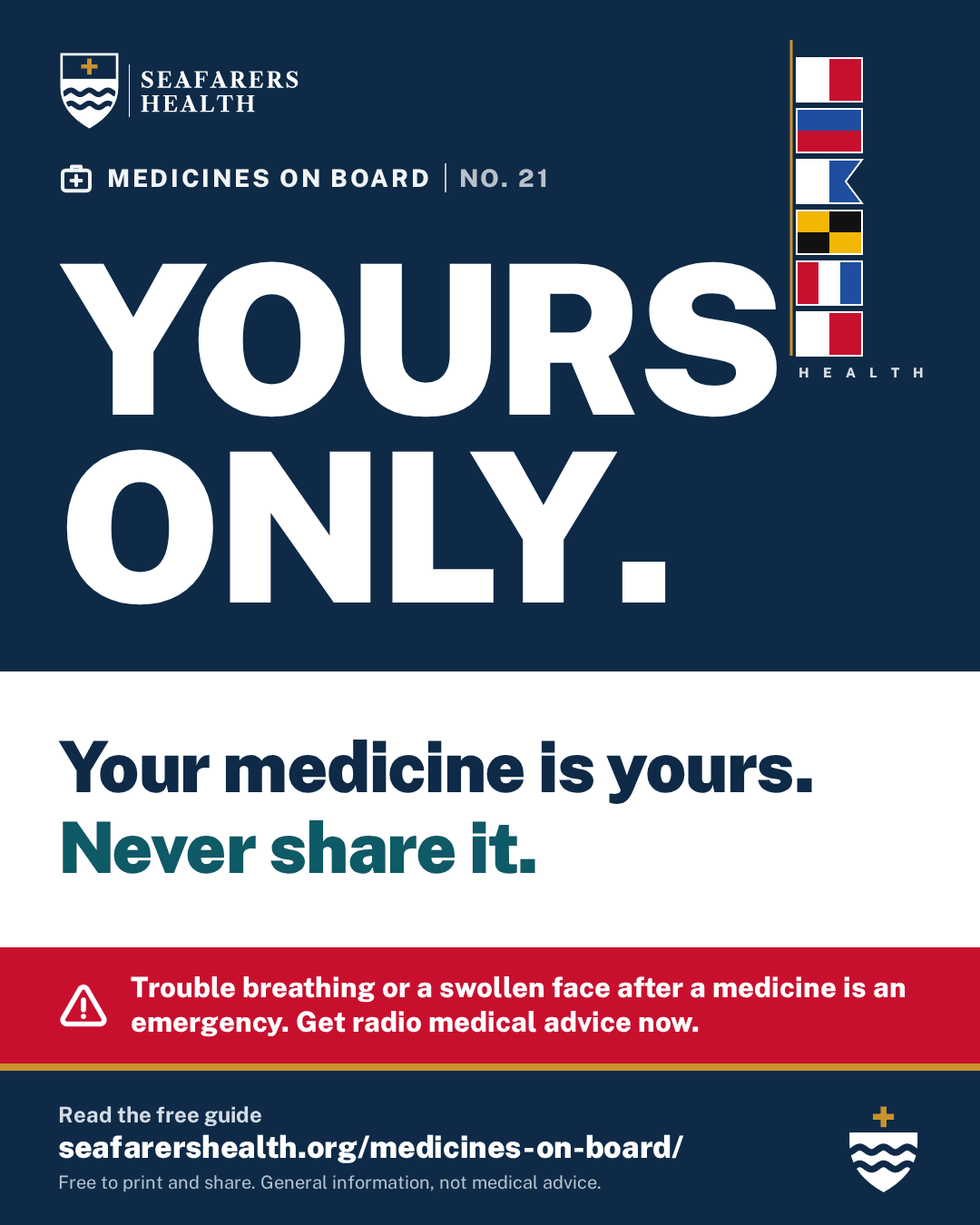
Poster for the mess room
Free to print and share. Pin it up this week.
Sources
- ILO Maritime Labour Convention 2006, as amended, Standard A4.1 and Guideline B4.1.1 (checked 2026-11-15)
- ILO/IMO Guidelines on the medical examinations of seafarers, Appendix D (medication) (checked 2026-11-15)
- WHO International Medical Guide for Ships, 3rd edition (checked 2026-11-15)
- INCB: General information for travellers carrying medicines containing controlled substances (checked 2026-11-15)
- GOV.UK: Take medicine in or out of the UK (checked 2026-11-15)
- WHO Hypertension fact sheet (do not miss or share medication) (checked 2026-11-15)
- NHS: Antibiotics (checked 2026-11-15)
Know a shipmate who might need this? Send them this guide. It is free and it loads on slow ship internet.
Send on WhatsAppDid this help you?
Thank you. Please send it to a shipmate who might need it.
Thank you. What was missing? Tell us and we will improve it.
Seafarers Health. seafarershealth.org/medicines-on-board/ Last updated 15 November 2026. General information, not medical advice. Free to print and share.