
Medical certificates
Your PEME in the Philippines
Filipino seafarers must pass a pre-employment medical examination (PEME) before a contract at sea. By law, it must be done at a clinic accredited by the Department of Health (DOH).
A PEME can decide your next contract. Here is how to get ready, so you go in calm.
The short version
- Your PEME must be done at a DOH accredited clinic.
- Agencies cannot charge you placement fees or visa costs.
- The cost of your medical certificate may be charged to you.
- You have the right to a copy of your results.
- Be honest about your health history. The law says you must.
We wrote this from the sources at the end. Last checked . We're looking for a doctor to review every page. How we write. Spot a mistake? Tell us.
What the law says
The Magna Carta of Filipino Seafarers (Republic Act No. 12021) became law in September 2024. It says:
- Every PEME for a seafarer going overseas must be done only at a DOH accredited clinic. The clinic must follow DOH standards.
- You must get a medical certificate from a DOH accredited clinic after your PEME before you work on an ocean-going ship.
- A medical certificate that meets the STCW Convention is also accepted. STCW is the international convention on seafarer training and certificates.
- You must answer all questions about your health history truthfully. Your health data is protected by the Data Privacy Act.
Who arranges the PEME and who pays?
Your manning agency usually sends you to a clinic. A manning agency is the licensed agency that hires you for the shipowner.
The law says agencies must not charge you or your family any recruitment or placement fees, or visa costs. The only costs that may be charged to you are:
- getting your medical certificate
- your seafarer's record book (SRB)
- your passport or similar travel papers
So you may be asked to pay for your medical certificate. Before the exam, ask the agency in writing what you will pay for and what each test costs. If you think you were charged a fee that is not allowed, contact the Department of Migrant Workers (DMW).
How to check your clinic is accredited
Get the clinic's full name
Ask your agency for the clinic's name and address in writing.
Check it with the DOH
The Department of Health accredits these clinics. Check the clinic is on the DOH's current list. You can also ask the DMW.
Keep your papers
Keep your receipts and a copy of your results.
We do not copy the clinic list here, because it changes. Always use the DOH's own list.
The usual tests
The DOH sets what the exam must include, and employers can add tests. A PEME often includes:
- your health history and a full physical exam
- eyesight, colour vision and hearing
- blood pressure, heart and lungs
- blood and urine tests
- a chest X-ray and an ECG (a heart tracing)
- a dental check
- a drug test
- a check that you can do your duties, such as climbing ladders
Ask the clinic or agency for the full list before you go.
Fit, unfit or pending
- Fit: you meet the health standards for your job. You get your medical certificate.
- Unfit: a health problem stops you working at sea for now. Under the ILO/IMO guidelines, this can be temporary (less than two years) or permanent.
- Pending: the clinic needs more tests or a specialist report before it decides. Do the extra tests fast.
Under the same guidelines, a doctor can also give you a certificate with a restriction, such as some duties only. Or they can give a shorter certificate so they can check you again sooner.
Hepatitis B
The ILO/IMO guidelines do not make a hepatitis B result an automatic fail. The doctor decides case by case, based on your liver tests, how infectious you are, your duties and your voyages. Bring any results and letters from your own doctor.
What to bring and how to prepare
A month or two before
See your own doctor and dentist. Get blood pressure, blood sugar and tooth problems treated now.
The week before
Avoid alcohol. Take your usual medicines as normal. Ask the clinic if you need to fast before blood tests.
The night before
Sleep well. Pack your papers.
On the day, bring
Valid ID or passport, your SRB, your glasses or lenses, your last medical results, a list of your medicines, and letters from your own doctor about any long-term health problem.
If you are found unfit
Ask why, in writing
Ask the clinic what the problem is and what would change the result.
Get your results
The law says you must be given the results of your medical exam.
Treat what can be treated
Many problems, like high blood pressure, high blood sugar or bad teeth, can be treated. Then you can ask to be checked again.
Ask for a second check
MLC 2006 gives seafarers who are refused a certificate the right to a further exam. This is done by another independent doctor or a medical referee. A medical referee is an independent doctor who looks at the decision again. Ask the clinic and your agency how this works.
Get help
If you think you were treated unfairly, contact the DMW, your union or SeafarerHelp.
If you get sick or hurt during a contract
The law says medical care on board and ashore is at no cost to you. If you still need care when you get home from a work illness or injury, you must have a post-employment medical exam. A company-designated doctor does this exam.
Report within 3 working days
Go to the company-designated doctor within 3 working days of getting home, unless you are too ill to travel. If you are too ill, tell the company in writing within the same time. If you miss this, you can lose your right to sickness and disability benefits.
If you disagree with that doctor, you can see a doctor of your choice. If the two doctors disagree on your disability grade, you have 30 days from your doctor's findings to ask the DMW in writing for a third doctor. The third doctor's grade is final for both sides. Read more in your health rights.
When does your medical run out?
Pick your certificate and the month it runs out. Get a reminder 90, 60 and 30 days before, so you have time to book.
Get ready for your PEME
Your manning agency usually tells you which clinic to use. Tick these off before you go. Your ticks stay on this phone.
Common questions
Where can I take my PEME in the Philippines?
Only at a clinic accredited by the Department of Health (DOH). Your agency usually names the clinic. Check it is on the DOH's current list.
Who pays for the PEME in the Philippines?
The law allows the cost of your medical certificate to be charged to you, but no recruitment or placement fees and no visa costs. Ask your agency in writing what you will pay before the exam.
How long is a PEME valid?
A seafarer medical certificate is valid for up to two years under MLC 2006, but your employer may ask for a new PEME before each contract. Ask your agency what they accept.
What does pending mean on my PEME result?
It means the clinic needs more tests or a specialist report before it decides. Do the extra tests quickly and keep copies of all results.
Can I work with hepatitis B?
Often, yes. The ILO/IMO guidelines say the doctor decides case by case, based on your liver tests, how infectious you are and your duties. It is not an automatic fail.
What can I do if I am found unfit?
Ask why in writing, get a copy of your results, treat what can be treated, and ask about a second check by an independent doctor. Contact the DMW or your union if you think it was unfair.

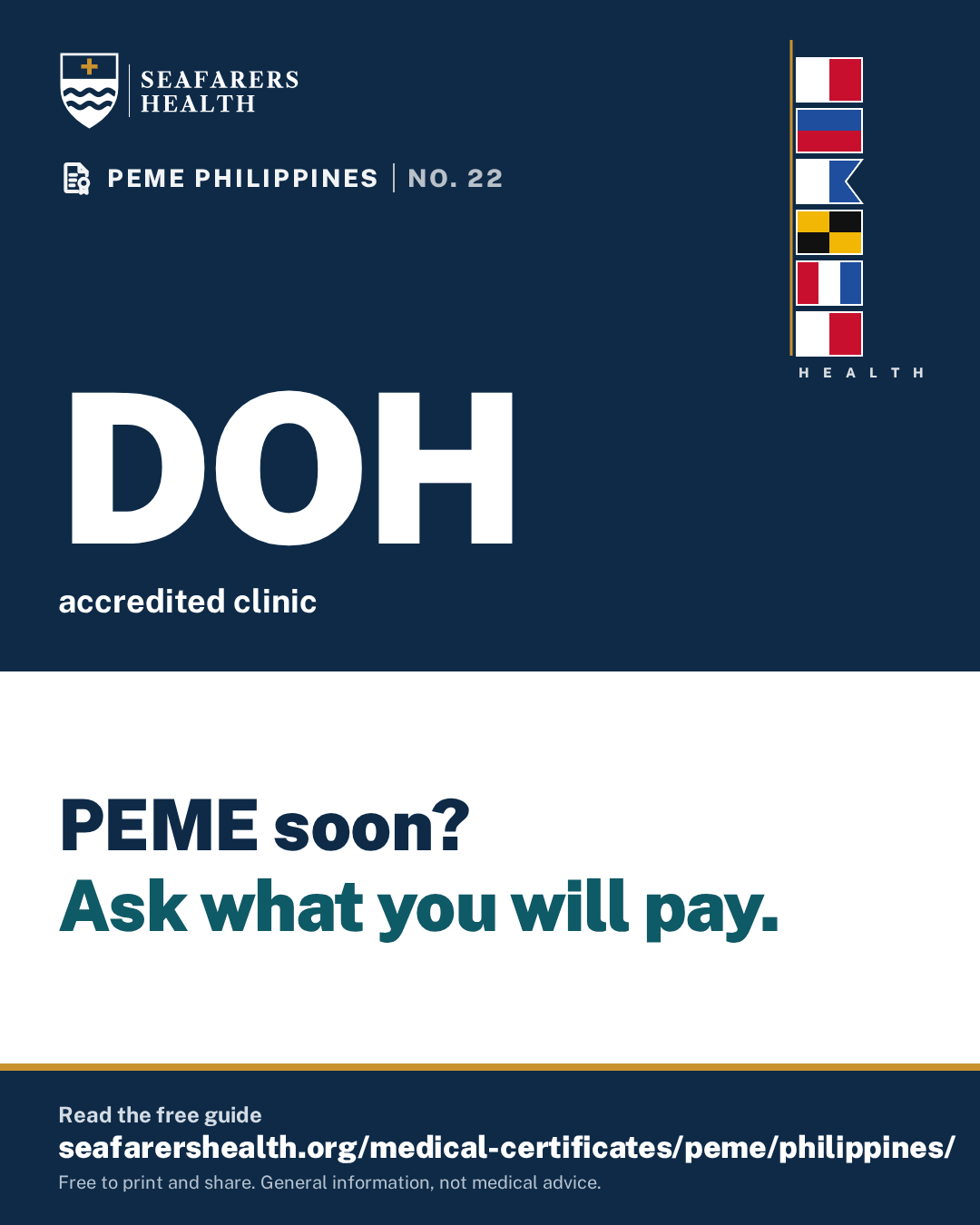
Poster for the mess room
Free to print and share. Pin it up this week.
Sources
- Republic Act No. 12021, Magna Carta of Filipino Seafarers, Sections 10, 28, 29, 31, 48 and 57 (full text via Lawphil, checked on 2026-11-15)
- ILO/IMO Guidelines on the medical examinations of seafarers, Part 3 and Appendix E (checked on 2026-11-15)
- ILO: MLC 2006 consolidated text, Standard A1.2 and Standard A1.4 (checked on 2026-11-15)
- Department of Migrant Workers (DMW), Philippines (checked on 2026-11-15)
- Department of Health (DOH), Philippines (site blocks automated checks, checked on 2026-11-15)
Know a shipmate with a medical soon? Send them this guide. It is free and it loads on slow ship internet.
Send on WhatsAppDid this help you?
Thank you. Please send it to a shipmate who might need it.
Thank you. What was missing? Tell us and we will improve it.
Seafarers Health. seafarershealth.org/medical-certificates/peme/philippines/ Last updated 15 November 2026. General information, not medical advice. Free to print and share.