
Health guide
Women's health at sea
Ships are still mostly built and stocked with men in mind. A little planning before you join makes a long contract easier. You also have rights on board, and help is there if you need it.
Practical answers to the questions women at sea ask most.
The short version
- Pack enough period products for the whole contract, plus extra.
- The MLC 2006 requires separate toilets and sleeping rooms for men and women.
- Long-acting contraception lasts for years and does not need a daily pill.
- Uncomplicated pregnancy is often fit for work until about week 24, under the ILO/IMO guidelines.
- You have the right to complain to the master without punishment.
We wrote this from the sources at the end. Last checked . We're looking for a doctor to review every page. How we write. Spot a mistake? Tell us.
Periods and supplies
- Pack enough pads, tampons or a menstrual cup for the whole contract, plus extra. Port shops may not have what you use.
- Ask about disposal before you join. In a 2015 survey of 595 women seafarers, 37% said they had no sanitary bin in the toilet. If there is none, tell the master or your company.
- Heavy or painful periods are worth checking with a doctor before your contract. There are treatments that can help.
The MLC 2006 says ships must have separate sanitary facilities and separate sleeping rooms for men and women.
Contraception for long contracts
Plan this with a doctor or nurse a few months before you join.
- Long-acting methods last for years. The implant works for 3 years and is more than 99% effective. The coil (IUD) and the hormonal coil (IUS) also last for years.
- The hormonal coil can make periods lighter, shorter or less painful. That can help on a long contract.
- If you use the pill, take enough packs for the whole contract plus extra.
- Only condoms also protect against sex infections. See sexual health.
Emergency contraception is time-limited
The emergency pill must be taken within 3 days or 5 days of sex, depending on the type. The sooner the better. A copper coil fitted within 5 days also works. Many ships do not carry the emergency pill. Pack your own before you join.
Pregnancy and your fitness to work
Flag states set their own rules, and many follow the ILO/IMO guidelines on seafarer medicals. In general terms, these guidelines say:
- An uncomplicated pregnancy, with no problems that affect your work, is normally fit until about the 24th week.
- Late pregnancy and the time just after birth are normally unfit for sea service.
- A pregnancy that needs close medical care is unfit for a time.
- You should tell the doctor early, so you can get the checks and care you need.
Pregnant and unwell at sea
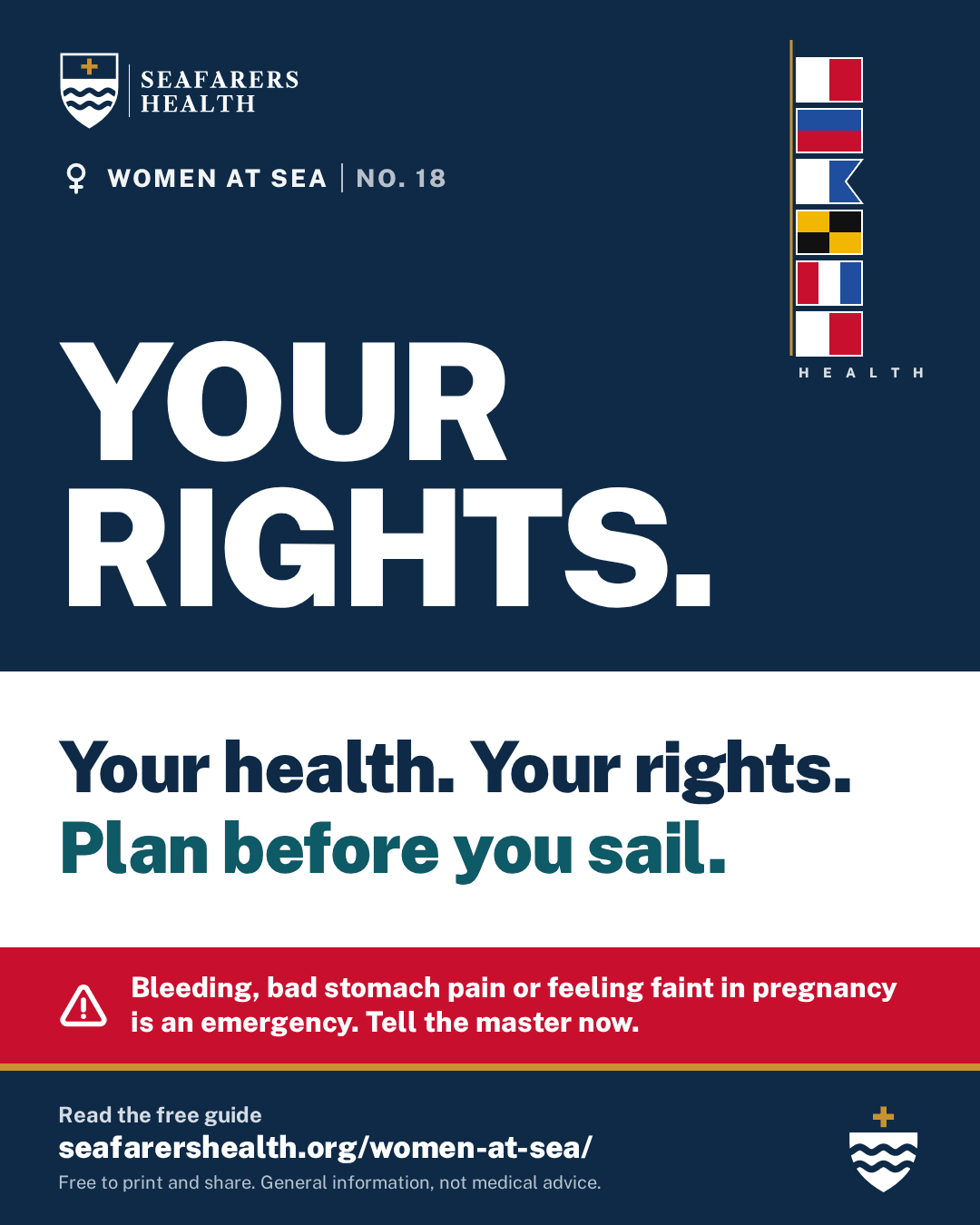
Bleeding, bad stomach pain or feeling faint in pregnancy is an emergency. Alert the master or the officer in charge of medical care and get radio medical advice at once.
Safety gear that fits
The MLC 2006 says seafarers must get personal protective equipment in the right sizes. Gloves, boots, overalls and harnesses that are too big are a danger. Ask for your sizes before you join.
Harassment and where to get help
In the 2015 survey, 18% of women said sexual harassment was an issue at sea. You do not have to put up with it.
- Complain on board. Under the MLC 2006, every ship must have a fair complaint procedure. You have the right to complain directly to the master, and to outside authorities. You must not be punished for making a complaint.
- Ask for the name of the person on board who can give you private advice. It must be in the complaint procedure you get with your contract.
- Talk to someone in private. SeafarerHelp is free, private and open 24 hours a day. Phone +44 20 7323 2737, or use WhatsApp, email or live chat at iswan.org.uk/seafarerhelp.
- Contact a union inspector. The ITF has inspectors in many ports.
New MLC rules on violence and harassment were agreed in 2025. They name sexual harassment, bullying and sexual assault. They are expected to come into force in December 2027.
If you have been assaulted
Go to a safe place. Tell the master or an officer you trust. Get radio medical advice. Medicine to prevent HIV (PEP) must start within 72 hours. Emergency contraception works best when taken soon.
Common questions
Can I work at sea while pregnant?
Often yes, in early pregnancy. Under the ILO/IMO guidelines, an uncomplicated pregnancy is normally fit until about the 24th week. Your flag state sets the final rules, so tell the doctor early.
What should women pack for a long contract at sea?
Pack period products, contraception and any regular medicines for the whole contract, plus extra. Bring work gear in your size if the company cannot supply it. Port shops may not stock what you need.
What contraception is best for a long contract?
Long-acting methods such as the implant or a coil are a good fit, because they last for years. Talk to a doctor or nurse a few months before you join. Use condoms too, to prevent sex infections.
Where can women seafarers report harassment?
You can complain on board and directly to the master, and to outside authorities. You must not be punished for it. For private support, contact SeafarerHelp, which is free and open 24 hours a day.
What if there is no sanitary bin on board?
Tell the master or your company. The MLC 2006 requires separate sanitary facilities for women. Ask about disposal before you join next time.
Quick self-check
Tick what is true for you. Your answers stay on this phone.
Want a monthly all-round check on paper? Get the Fit on Board self-check (PDF, 29 KB).

Poster for the mess room
Free to print and share. Pin it up this week.
Sources
- MacLachlan and others, Women seafarers' health and welfare survey, International Maritime Health 2015 (checked 2026-11-15)
- ILO Maritime Labour Convention 2006, as amended (Standards A3.1, A4.3, A5.1.5) (checked 2026-11-15)
- ILO: 2025 amendments to the Code of the MLC 2006 (violence and harassment) (checked 2026-11-15)
- ILO/IMO Guidelines on the medical examinations of seafarers, Appendix E (pregnancy) (checked 2026-11-15)
- NHS: Contraceptive implant (checked 2026-11-15)
- NHS: Hormonal coil (IUS) (checked 2026-11-15)
- NHS: Emergency contraception (checked 2026-11-15)
- SeafarerHelp, run by ISWAN (checked 2026-11-15)
- ITF: Find an inspector (checked 2026-11-15)
Know a shipmate who might need this? Send them this guide. It is free and it loads on slow ship internet.
Send on WhatsAppDid this help you?
Thank you. Please send it to a shipmate who might need it.
Thank you. What was missing? Tell us and we will improve it.
Seafarers Health. seafarershealth.org/women-at-sea/ Last updated 15 November 2026. General information, not medical advice. Free to print and share.