
About us
Why Seafarer Health Matters
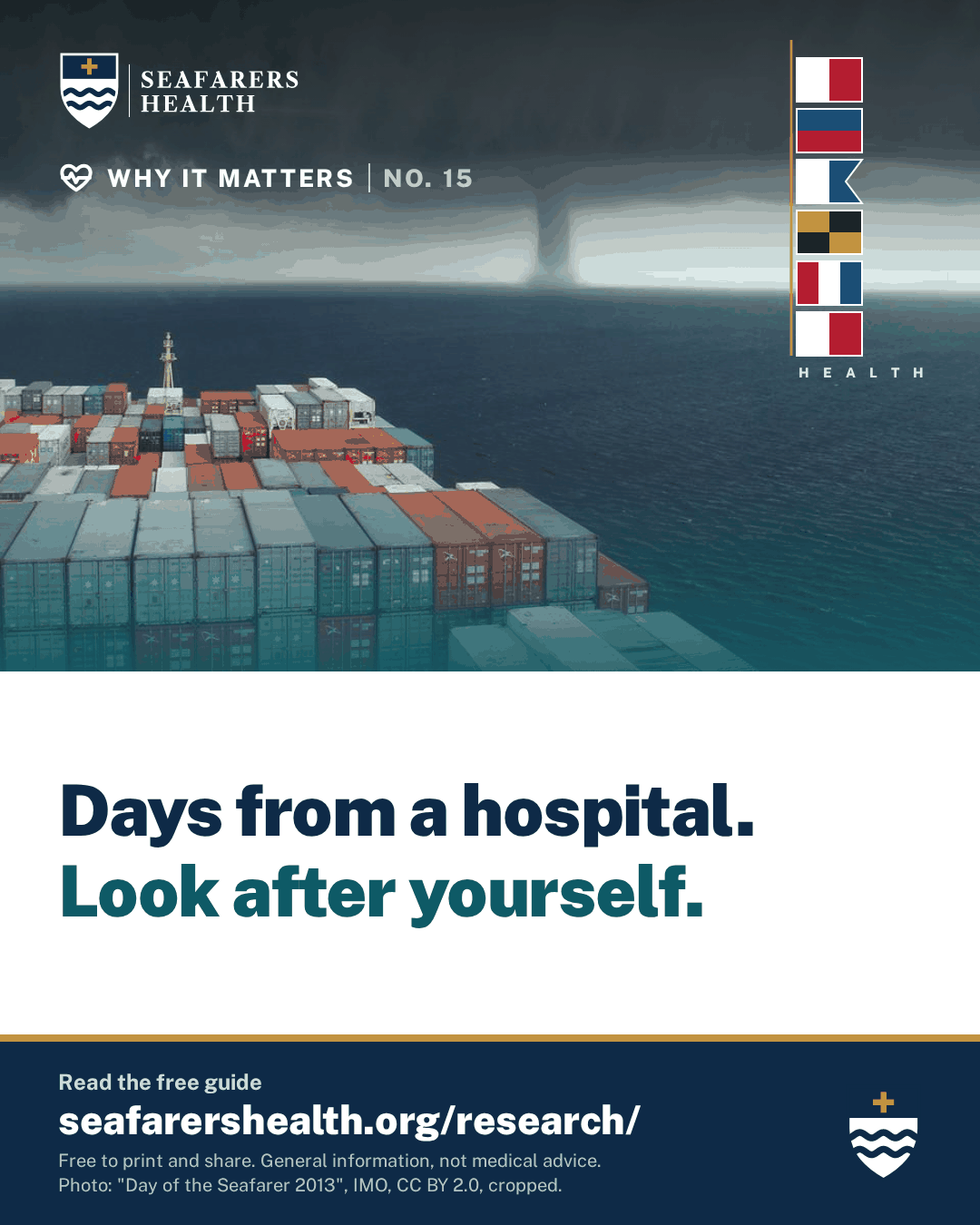
On a ship in mid-ocean, the nearest hospital can be days away. That one fact shapes seafarer health. At sea, prevention is your main defence.
The short version
- Ships carry a medicine chest and trained crew, not a hospital.
- Free radio medical advice is there 24 hours a day.
- In one big study, illness at sea was more common than injury.
- Night watches and long voyages raise fatigue.
Last updated .
Far from care
Ships carry a medicine chest. Some crew are trained in first aid and medical care. Under MLC 2006, ships can also get free radio medical advice from doctors ashore, 24 hours a day.
But that is basic care. A helicopter can only fly so far, and the weather has to allow it. The ship may need to change course. The choice to evacuate is made with the radio medical service and the rescue centre. So always ask. Most sick or hurt seafarers stay on board until the next port.
Illness is common at sea
A study looked at 3,921 medical cases from ships, sent to a telemedicine service from 2008 to 2011. Illness made up 70.5% of the cases. Injury made up 29.5%. Stomach, skin and breathing problems were the most common illnesses that stopped people working. (Lefkowitz and others, 2015.)
The same team looked at who was sent home. Most people sent home were ill, not injured. Back injuries and stomach illness were the top causes. (Lefkowitz and others, 2015.)
Fatigue is real
Project MARTHA was a three-year study of seafarer fatigue. It was run by universities and shipping groups and reported in 2017. It found that:
- night watchkeepers were most likely to fall asleep on duty
- sleep got worse on long voyages
- most seafarers felt more tired at the end of a voyage
- masters felt more tired at the end of a voyage than other crew
A working life with extra risks
- Your workplace is also your home. You live where you work, often for months. You have little choice of food, exercise or company.
- Hazards: noise, heat, heavy lifting, chemicals, ladders and the sea itself.
- Broken sleep: watches, port calls and time zones.
- Disease in port: malaria and other infections.
- Distance from home: long time away from family and patchy internet can hurt mental health.
What works
Health tips work best on board when they are short, practical and repeated. A poster in the mess room. A self-check once a month. A chat at the safety meeting. The ship can be a good place to build healthy habits, because the whole crew is together.
The rules behind it
MLC 2006 is the ILO's main law for seafarers. It says flag states must protect seafarers' health. This includes medical care on board and ashore, mostly at no cost to you. It also includes health promotion and education, not just treatment. Read more in your health rights.
Common questions
What is the most common medical problem at sea?
Illness is more common than injury. In one study of 3,921 ship medical cases, 70.5% were illness, with stomach, skin and breathing problems the top causes of lost work.
Can a helicopter always reach a ship?
No. It depends on distance, weather and the aircraft's range. Most sick or hurt seafarers stay on board until the next port, which is why prevention matters.
Is radio medical advice free?
Yes. MLC 2006 says medical advice by radio or satellite must be free for all ships, whatever flag they fly, 24 hours a day.

Poster for the mess room
Free to print and share. Pin it up this week.
Sources
- Lefkowitz RY, Slade MD, Redlich CA. Injury, illness, and work restriction in merchant seafarers. American Journal of Industrial Medicine, 2015 (checked on 2026-11-15)
- Lefkowitz RY, Slade MD, Redlich CA. Risk factors for merchant seafarer repatriation due to injury or illness at sea. International Maritime Health, 2015 (checked on 2026-11-15)
- University of Southampton: Project MARTHA, three-year study of seafarer fatigue, 24 February 2017 (checked on 2026-11-15)
- ILO: MLC 2006 consolidated text, Regulation 4.1 and Standard A4.1 (checked on 2026-11-15)
Did this help you?
Thank you. Please send it to a shipmate who might need it.
Thank you. What was missing? Tell us and we will improve it.
Seafarers Health. seafarershealth.org/research/ Last updated 15 November 2026. General information, not medical advice. Free to print and share.